

Welcome back to Behind the Scenes! Today, we’re talking about how I shape major plot threads: relationships, character growth, and other developments that may take the course of the entire book to work themselves out.

In yesterday’s chapter, we saw the resolution of the relationship between two characters, Koko and Eleanor:
Koko looked up at me, eager to tell the tale. “Eleanor sat with me at lunch today,” she said. “And then after a while, Dottie and Lois came over too.”
“And Annie,” Eleanor put in. “But she does whatever Lois tells her.”
“And Grace,” added Koko. “And then we all played jacks at recess.”
A small smile curved my lips. This was, perhaps, the most meaningful thing Eleanor could have done for Koko—to use her own social standing to bolster Koko’s. And I knew it had to have come at a cost. “Not Maggie, though,” I said.
“Nope,” Koko said happily. “Not Maggie.”
Eleanor shrugged. “She can sit with us if she wants,” she said. “It’s really up to her.”
The girls exchanged a delighted giggle, and I found myself beaming in admiration. I was so proud of Koko, for having helped Eleanor, even when it had seemed like there was nothing to gain. And I was proud of Eleanor, too, for having finally recognized Koko’s generosity, and responded in kind.
This relationship was always intended to be the heart of the story, but it was really difficult to get right. My editor, at one point, referred to it as being “all over the place.”This was bad, because I wanted the relationship to be deeply satisfying for the reader—and that meant it had to make sense.
One tool I take advantage of is the Collections feature in Scrivener. Scrivener is chock full of neat little tools, and sometimes the sheer number of them can make the whole interface seem a little overwhelming. But Collections are pretty simple. I can right-click on any document in my project to add it to a Collection. That Collection then becomes a selectable option on the left side of my Scrivener window, and I can click on it to view just those documents that have been added to it.
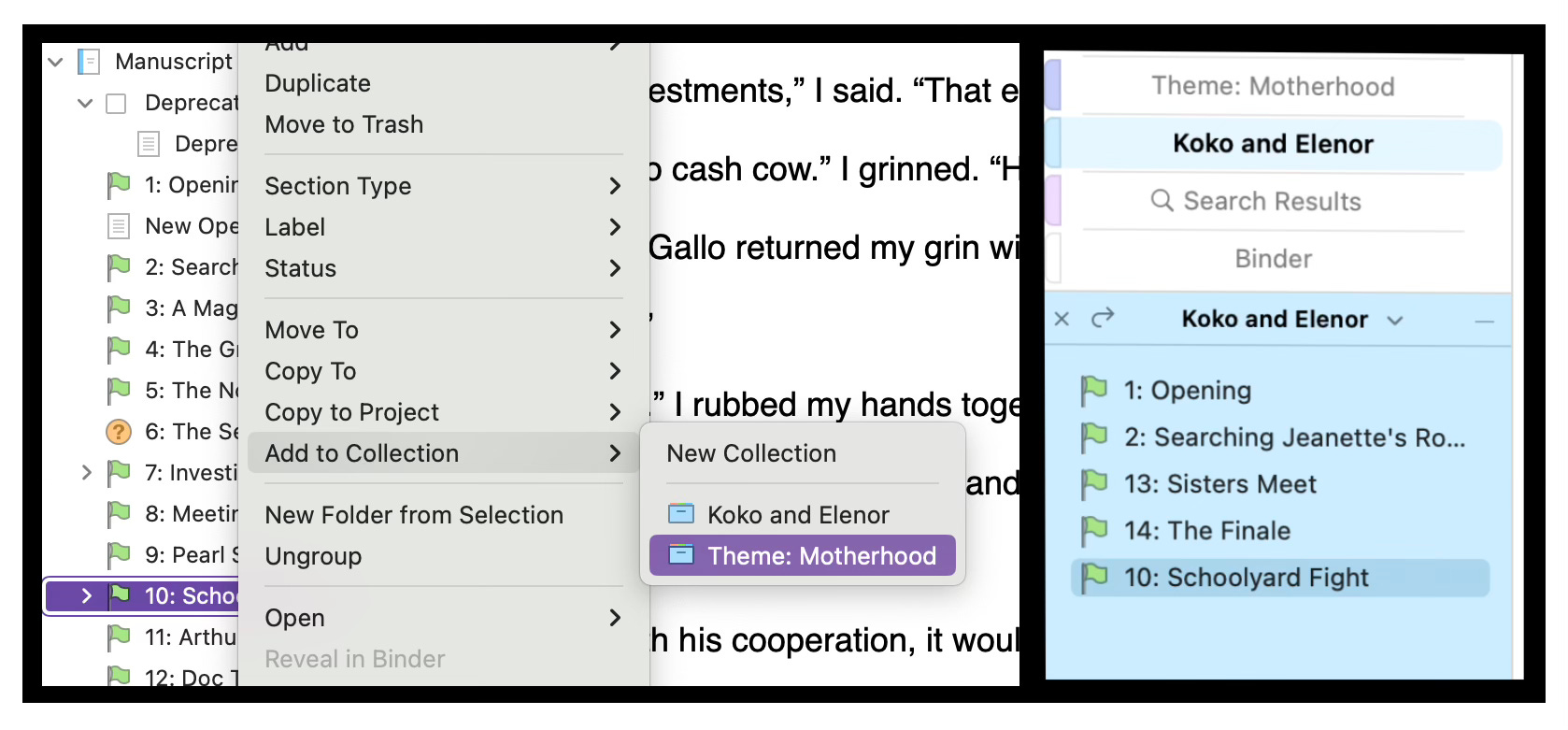
I find this really useful. It lets me read through the scenes that relate to a single major thread. You can see that this book has two threads I put into collections: Koko & Eleanor, which is about the relationship between those characters, and Theme: Motherhood, which is about Kitty’s thoughts about parenting Koko. It’s nice to have a simple way to group these together, so that I can read through any thread quickly, without any interleaving material. That makes it easier to see whether things are adding up—whether the issues at play get pulled along through every scene, instead of getting forgotten or distorted or confused. That may not sound like a huge danger—but when you’re working on a book over months or years, such things can easily happen.
I often think that good writing is about making sure the reader can understand, at any moment, exactly where each character’s head is at—what they’re thinking and feeling, what they are trying to convey with their actions. The Collections feature really helps me get that stuff straight in my own mind, so I can convey it clearly to the reader.
All the best,

I love how you always have a way to see which element is working with the entire book so we don't get plot holes or leave anything dangling! Mucho importante...
Thanks for telling us about the Collections feature. I use Scrivener, but was not familiar with that feature.